Group Exhibition
27.11-19.12.2026
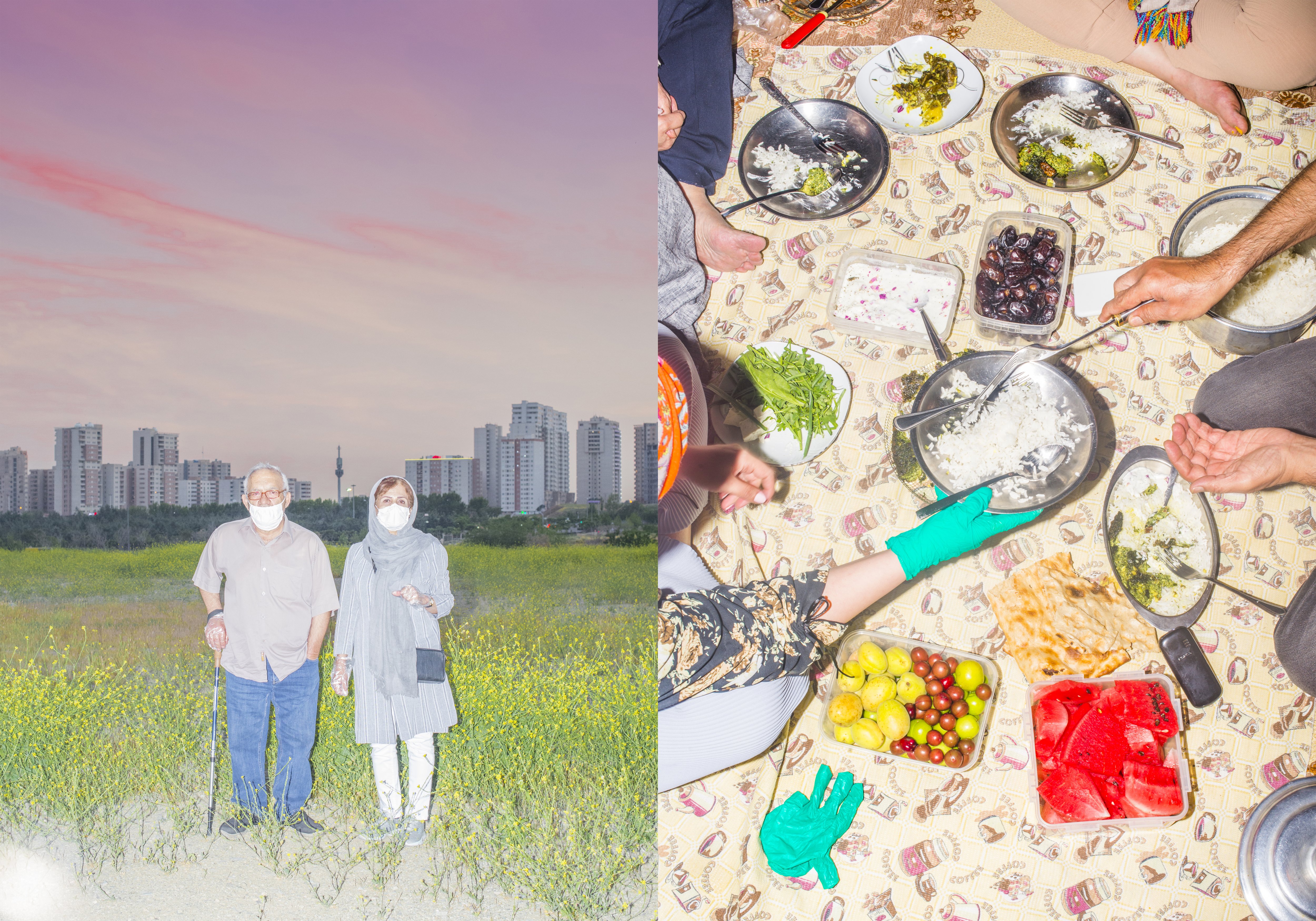
With Sofreh-ye del – The Open Cloth, Anahita Sadighi Gallery turns to the sofreh, the cloth spread out for shared meals in Persian culture, to reflect on hospitality, solidarity and community. The Persian idiom sofreh-ye del ra baz kardan, literally ‘to open the cloth of the heart’, means to open up and speak from the heart. Here, the sofreh stands as a counter-altar to another renowned table: the Last Supper. Where the Last Supper is hierarchical and marked by farewell and betrayal, the sofreh is spread on the floor as an open invitation – a space to gather, unite and connect, without boundaries or fixed roles. Sofreh-ye del moves the shared meal beyond any religious context and turns it into a place of continuous presence. Yet presence always holds its counterpart – absence – and this is the underlying question of the exhibition. Every work asks who has a place on this shared cloth and who is missing.
The exhibition brings together four artistic positions. Mexican artist Maria Portilla uses textiles and painting to give voice to people living on the margins. Ranging from the impact of addiction to precarious living conditions, her contemporary still lifes map the psychological boundaries of modern temptation, societal control and personal freedom. We are what we eat and we are also defined by what we desire. Portilla’s work is closely tied to her deep commitment to social justice: she is the founder of Mi Valedor, Mexico’s first street paper, sold by people in vulnerable situations. For her, connection is the key to moving from the personal to the collective.
In the artist’s own words: ‘There is no turning back, yet there are ways to inhabit the present that will alter the contours of the future: mending the social fabric through practices that bring us closer to our humanity. Remembering that we have been witnesses to these moments – moments that, like connections, rhizomes or spiderwebs, allow us to weave together our HUMAN fabric.’
Iranian photographer Hashem Shakeri carries the conversation into a wider, more public space. His series Untitled (The Baron in the Trees) shows how communal meals can become a way of reclaiming space in the face of restrictions imposed by the pandemic or by social norms. As a documentary photographer, Shakeri explores themes such as displacement and resilience, creating a universal tension between a place lost and a place reclaimed.
Hamid S. Neiriz draws on archaeology and ancient mythologies to reflect on painting and on human nature. Influenced by mysticism and the history of religion, his paintings carry the conversation to a universal level, where the borders between time and space collapse and we are left with our truest, interwoven selves.
At the centre of the exhibition is an installation by Sherry Shayan that draws directly on the imagery of the sofreh. On its activation days, visitors are invited to make torshi together. These traditional Persian pickles are a time-honoured way of preserving food, and making them together creates a new space for collectivity while reflecting on food waste and distant connections. The sofreh is also brought to life by those who cannot be present: through a fundraiser organised in collaboration with Hamdeli, people from Iran become part of it. Here, the stories and meals of those who are far away find a space where they can coexist with ours, and sharing takes on a deeper meaning. The installation remains active even when it is empty. It becomes a place where those who are absent – our missing loved ones and distant friends – can come and sit with us again. It is on this sofreh that we will all be reconnected.
